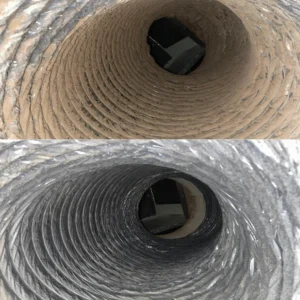
Pull the filter out of a Phoenix return vent at the end of summer and it tells you most of the story. The side facing the room has gone gray. Sometimes it is close to solid. That is months of desert dust, pet hair and whatever blew in during the last monsoon storm, all caught before it reached your blower.
That is the filter doing its job. The real question is how long you let it keep doing it.
The short answer
ENERGY STAR’s home maintenance checklist says to inspect, clean or change the air filter once a month in your central air conditioner, furnace or heat pump. Once a month to look at it. Not necessarily once a month to replace it.
How often you actually swap it depends on what kind of filter you bought. Carrier, the air conditioner maker, publishes intervals by filter type, and they line up with what we see in Valley homes.
Thin fiberglass filters
These are the flat, see-through ones that cost a couple of dollars at the hardware store. Carrier says to replace a 1-inch fiberglass filter every 30 days. They are cheap because they do not catch much, and they fill up fast.
Pleated 1-inch filters
The folded paper-style filters most people buy now. Carrier’s range is every 30 to 90 days. In a Phoenix house that range shrinks, for reasons we will get to in a second.
Thick 4-inch media filters
If your air handler has a deep cabinet slot, it may take a 4-inch media filter. Carrier puts those at every 6 to 12 months. More material means more room to hold dust before airflow suffers.
Why Phoenix homes land on the short end
Carrier’s own guide says two things change the schedule: how dusty the house is and how hard the system runs. Homes with pets or high dust levels may need a new filter as often as every month, and a system that runs nonstop goes through filters faster. Carrier’s example is a hot Florida summer.
A Phoenix summer is the same problem without the humidity. The AC barely shuts off from late spring into fall, so every hour it runs is another hour of air pulled through that filter. Add the fine dust that sits on everything here, plus the storms that push it through door gaps and attic vents, and a pleated filter rated for 90 days is often done well before then.
Our rule for Valley homes is simple. Look at it every month from May through October. If you cannot see light through it when you hold it up, change it, no matter what the package says.
Worth understanding: a filter protects your equipment before it does anything for the air you breathe. That is why the EPA ties its advice on higher-rated filters to one condition, that the filter has to suit your system fan and filter slot. If a denser filter makes your AC struggle, it is the wrong filter for that system, not a better one.
What happens when you wait too long
ENERGY STAR puts it plainly: a dirty filter can increase energy costs and damage your equipment, leading to early failure.
Here is the practical version. A clogged filter chokes the air coming back to the system. The blower works harder to move less air, rooms take longer to cool, and the system runs longer cycles to get there. On a 115-degree afternoon that is the last thing you want your AC fighting.
There is a second cost people miss. Once a filter is packed, some of the air can find a way around it through gaps in the frame or the slot. That air is not filtered at all, and the dust in it settles inside the system and the ductwork instead of on the filter you were going to throw away.
Which filter should you buy?
Filters are rated by MERV, short for Minimum Efficiency Reporting Value. The EPA explains it as a measure of how well a filter captures particles between 0.3 and 10 microns. The higher the MERV number, the better it is at trapping those particles.
If you want to upgrade, the EPA recommends a filter rated at least MERV 13, or as high a rating as your system fan and filter slot can handle. That second part matters.
Higher is not automatically better for your system
A denser filter catches more, but it also resists airflow more. Some systems handle a MERV 13 without a problem. Others struggle with it. The EPA’s own advice is that you may need an HVAC technician to tell you the highest-efficiency filter that works for your system. If your AC already has trouble keeping up in July, ask before you jump to the densest filter on the shelf.
The size has to match the slot
The dimensions are printed on the edge of the old filter, something like 16 x 25 x 1. Buy that exact size. A filter that is a little small leaves a gap, and air takes the easy path around it.
What about HEPA?
You will see HEPA on air purifier boxes and wonder why your AC filter does not say it. The EPA notes that HEPA filters are a type of pleated filter common in portable air cleaners, and that they are not rated on the MERV scale at all. For the slot in your return, MERV is the number to compare. A portable HEPA unit in a bedroom is a separate decision from the filter your AC uses.
Where to find your filter
In many homes the filter sits behind a large return grille in a hallway ceiling or wall. In others it slides into a slot at the air handler itself, in a closet, the garage or the attic. Some homes have both, or more than one return with its own filter. If you have two systems, you have at least two filters to keep track of.
If the grille is screwed shut or you cannot find a filter at all, that is worth a look from a technician. A system running with no filter is pulling dust straight into the equipment.
How to change it without making a mess
Turn the system off at the thermostat first, so it is not pulling air while the slot is open. Slide the old filter out slowly and keep it flat. The dust on the face falls off easily, and you do not want it landing in the return.
Check the size on the frame, then look for the arrow on the new one. The arrow shows the direction of airflow and should point toward the air handler, away from the room. Put it in backwards and it filters worse than it should.
Write the date on the frame with a marker before you close it up. Next month you will know exactly how long it has been in there, instead of guessing.
Pets, remodels and other reasons to go monthly
Carrier says homes with multiple pets should check the filter every 30 days, and high-shedding pets may mean changing it more often than that. If you have a dog and a cat in a Phoenix house, plan on monthly. We wrote more about this in our guide to duct cleaning for homes with pets.
Remodeling is the other big one. Drywall sanding and tile cutting put out a fine dust that loads a filter in days, not months. Change it during the project and again when the work is done. Our post on dust after a remodel covers what that dust does once it gets into the ducts.
And after a big monsoon dust storm, check it that week. It is the cheapest thing in your house to replace.
Leaving for the summer?
If you head north when it heats up, change the filter before you go, even if it looks fine. The AC keeps running to protect the house while you are gone, and nobody is home to notice when the filter fills up. Put a fresh one in when you get back, too. Our post on snowbird homes and air ducts covers what else to check when a house sits closed up for months.
A clean filter does not clean your ducts
This is where a lot of homeowners get stuck. A new filter only catches what passes through it from today forward. It does nothing about the dust that already got past an old, packed filter and settled in the return ducts, the blower and the coil.
So if you are changing filters on schedule and still wiping dust off every surface, the filter is not the problem anymore. That dust is coming from somewhere inside the system. Our guide to why your house is so dusty walks through the usual sources, and how often air ducts should be cleaned covers the schedule for the ductwork itself.
When to call us instead
A few signs say the system needs more than a new filter. A fresh filter turning gray in a couple of weeks. Dust that comes right back after you clean. Black dust around the vents. A musty smell when the AC kicks on.
The Unmatched $499 Complete-System Clean
One HVAC system. Ducts, returns, registers, air handler, blower, coil and dryer vent. Every component brushed, vacuumed and disinfected. Nothing due up front, and we do not accept payment from unhappy customers.
Our price list also includes an electrostatic filter for $139. Ask about it when you call and we will tell you whether it fits your system.
We know Phoenix
We are a family-owned team that has been cleaning Valley air ducts and dryer vents since 2015, and we see what a Phoenix summer does to a filter every week. If yours keeps filling up faster than it should, give us a call and we will look at the whole system, not just the slot.
Forever Vent, 2720 E Thomas Rd, Building C, Unit 270, Phoenix, AZ 85016. Call (623) 200-4222. Open 24 hours a day, 7 days a week.