When somebody calls us from a Scottsdale address, the first useful question is which Scottsdale. A 1962 ranch off Hayden and a 2004 hillside custom house up past Pinnacle Peak share a city name and almost nothing else that matters to us. The ductwork is different, the way the house is built is different, the way it gets used through the year is different, and the things that go wrong are different.
Most advice written about duct cleaning in this city ignores that and averages the two together, which produces advice that is wrong for both. So this is written as two answers rather than one.
Scottsdale is two cities for our purposes
The older core, roughly south of the 101, is mid century housing. Single storey, often flat or low slope roofs, systems that have been replaced two or three times over original duct runs. The newer stretches north and east are large, frequently custom, built from the nineties onward, with high ceilings, multiple systems and long runs through very hot attics.
Both are legitimately Scottsdale. They just present completely different problems, and the honest version of this post has to say which one you are in before it says anything useful.
The older side, south of the 101
Original ductwork under a flat roof
A lot of these homes have duct running through a shallow space under a low slope roof, which gets hotter than a conventional attic and is far harder to get into. The runs are frequently original to the house even where the equipment has been changed three times, because replacing ductwork means opening ceilings and almost nobody does it voluntarily.
What that means practically is a system where the mechanical parts are modern and the distribution is sixty years old. We see joints that have separated, insulation that has crumbled off, and sections that were never properly reconnected after some earlier piece of work.
What the remodels left behind
This part of Scottsdale has been renovated continuously for thirty years. Kitchens opened up, walls removed, additions added. Every one of those events puts drywall dust and construction debris into a system that was running at the time or was restarted without anybody cleaning it.
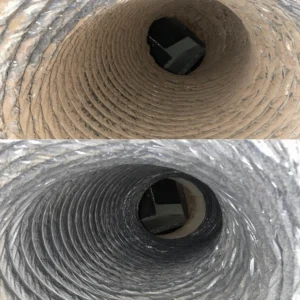
When we pull footage in one of these houses, the layered history of the remodels is usually visible in the ducts. It is the single most common thing we find on that side of town.
The newer side, north and east
Long runs and multiple systems
Larger homes are not simply more of the same. They typically have two or three separate systems, each with its own filter, its own coil and its own set of runs, and the runs themselves are much longer. That means more places for a problem to develop and more places for it to go unnoticed, because a fault in one system only affects part of the house.
It also means the maintenance most people think they are doing, which is changing one filter, is actually covering a third of the house.
The casita nobody services
Guest houses, casitas and converted garage suites usually have their own small system. They get used a few weeks a year. Nobody changes that filter, nobody has ever cleaned those runs, and the space sits closed and unconditioned in between. When guests do arrive, that is the system that produces a smell somebody notices immediately.
Desert landscaping changes what is in your air
A large share of Scottsdale is landscaped in decomposed granite rather than grass, and a good deal of it sits close to open desert and washes. That combination produces a fine mineral dust that behaves differently from the organic dust in a lawned neighbourhood. It is finer, it stays airborne longer, and it gets further into a system before anything catches it.
It is also relentless in a way that surprises people who moved here from somewhere green. This is the main reason filter intervals that worked fine elsewhere do not work here, and why a filter that looks acceptable at a glance can already be restricting airflow.
Houses that sit empty part of the year
Plenty of Scottsdale housing is a second home. The pattern that creates is specific. The house is closed for months with the system on a hold setting, running just enough to keep the building safe, circulating the same air through the same ducts with nobody there to notice anything.
Then the owners arrive, run everything at full output, and something they have not smelled in eight months is suddenly very obvious. If you own one of these, the useful time to have the system looked at is before a season starts, not the week after you arrive.
Remodelling is the single biggest event
Nothing else puts as much into a duct system as an hour of drywall sanding. Not years of ordinary living, not pets, not dust storms. If a house has been renovated and the system was not sealed off and cleaned afterwards, that is almost always the dominant thing in the ducts, and it is the one case where we would say do this now rather than wait.
Given how much of this city renovates, it is worth asking whoever sold you the house whether any work was done before you bought it. The answer is frequently yes, and frequently nobody dealt with it.
Zoned systems hide problems for longer
One zone quietly underperforming
Zoning is common in the larger homes and it is genuinely useful, but it also masks faults. A zone that is underperforming reads as a room somebody does not use much being a bit warm, which is easy to live with and easy to explain away for a couple of years.
By the time it becomes annoying enough to call about, whatever caused it has usually had a long time to develop. If you have a zoned system, the rooms you rarely enter are the ones worth checking, precisely because nobody is monitoring them.
What this does not need to be
It does not need to be annual. It does not need to be a maintenance contract. And it does not need to include a treatment or an air purifying product added on at the door, unless there is a specific reason somebody can point to and show you.
We would rather look at a system, tell a homeowner it is in good shape, and not see them for four years. That is a genuinely better outcome for both of us than a subscription neither side believes in.
How often, honestly
Every three to five years suits most Scottsdale households. Sooner after any renovation, sooner if there are several pets, sooner if a second home has been closed up and something smells on arrival, and sooner if somebody in the house has a respiratory condition that got worse without an obvious explanation.
For a house with no complaint, no remodel and no unusual history, waiting is a completely reasonable decision and we will say so.
What a visit actually looks like
We look at the system before quoting, and on a multi system house we look at each one, because quoting a large home as if it were a single system is how people end up with a number that changes on the day. You get a written scope with the vent and return count on it before anything starts, and you get footage from inside your own ducts afterwards.
That last part matters more in this city than most, because a lot of these homes are large enough that nobody could reasonably verify the work any other way.
The dryer vent is the part people forget
Almost every call we take is about the air conditioning ducts, and the dryer vent gets mentioned as an afterthought if at all. In the older Scottsdale homes that run is usually short and reaches an exterior wall quickly. In the larger newer houses the laundry is frequently somewhere in the middle of the floor plan, which means a long vent run with several bends in it before it gets outside.
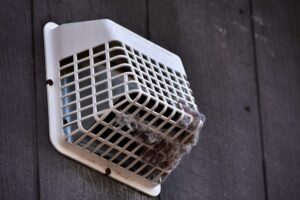
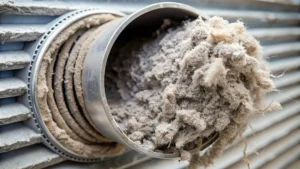
Long runs with bends accumulate lint faster and vent less effectively, and the first sign is almost always that towels need two cycles where they used to need one. That is a fire consideration rather than an air quality one, and it is the single most common thing we find that the homeowner had no idea was happening.
The $97 Duct Cleaning Special
For $97 per AC unit: a full ventilation system vacuum, one air return brushed top to bottom, one dryer vent cleaning, and a complete duct and vent video inspection so you see exactly what is going on inside.
We serve Scottsdale from our Phoenix location
We are family owned and have worked this valley since 2015. Scottsdale is covered out of our Phoenix office at 2720 E Thomas Rd, Building C, Unit 270, Phoenix. We are BBB accredited, we hold a 4.6 star rating across more than 640 Google reviews, every job carries a one year warranty, and we answer the phone 24 hours a day.
If you want somebody to tell you which of the two Scottsdales your house belongs to and what that means for your system, call us at (623) 200-4222 or book online. We will show you the footage and give you a straight number, including when that number is that you do not need us yet.