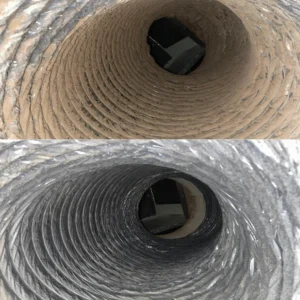
Duct cleaning sits in an awkward spot for rental property owners. It is invisible, tenants rarely ask for it, and no inspection requires it. So it gets deferred indefinitely, and then it turns into an HVAC repair bill, a turnover complaint, or a habitability argument you did not want to have.
Here is how to think about it as a line item rather than a nice-to-have.
Rentals accumulate faster than owner-occupied homes
This is not a knock on tenants. It is structural.
Filters get changed less consistently in rentals, because the person living there often does not know the size, does not own the property, and has no financial stake in HVAC efficiency. Turnover means periods where nobody is there and nobody notices anything. And a property that has cycled through several households has accumulated the residue of several different lifestyles, pets, cooking habits, and smoking histories.
The result is that a rental of the same age as the owner-occupied house next door frequently has a system in noticeably worse shape.
The three costs you are actually managing
Equipment life
Restricted airflow makes a system work harder for the same output. A blower caked with dust moves less air, a dirty coil transfers heat less efficiently, and the compressor runs longer to compensate. Longer runtimes on Phoenix summers are what puts equipment in an early grave.
Replacing an air handler or condenser is a capital expense. Cleaning is a maintenance expense. The math on deferring maintenance to avoid a small cost, then absorbing a large one, has never worked in anyone’s favor.
Turnover speed
A unit that smells musty at showing shows worse than one that does not, and prospective tenants make fast judgments on smell without being able to name what bothered them. Vacancy is expensive per day in this market. Anything that shortens time-on-market pays for itself quickly.
Complaints and disputes
Tenant complaints about air quality are difficult because they are hard to disprove and easy to escalate. A documented cleaning with video is a record. It moves the conversation from a subjective claim to something you can point at.
The practical value for a landlord: the video inspection is the part that matters most in your situation. It is timestamped evidence of the system condition, which is useful at turnover, useful in a dispute, and useful when you are deciding whether a property needs the work at all.
Turnover is the obvious window
Between tenants is when this is easiest and cheapest. The unit is empty, nobody needs to be scheduled around, techs can work without disruption, and you are already doing paint and carpet.
Adding duct work to your standard turnover checklist means it happens on a rhythm instead of when something breaks. For a property with two or three year average tenancy, that is a reasonable cadence on its own.
For longer tenancies, it is worth doing on a schedule anyway. A tenant who has been in place seven years is a tenant whose system has not been looked at in seven years.
The dryer vent is the one with real liability
Everything above is about cost and comfort. The dryer vent is about fire.
Lint is combustible, dryers generate heat, and a restricted vent traps both in the same place. This is a known fire cause and it is entirely preventable with periodic cleaning.
In a rental the risk profile is worse than in an owner-occupied home for a simple reason. Your tenant does not know when the vent was last cleaned, has no way to check it, and will not report a dryer that runs a little slow. They will just run it twice.
If you own multifamily, shared or stacked dryer venting raises this further, because a restriction affects more than one unit and no single tenant sees the whole picture.
Of everything on this page, an annual dryer vent cleaning is the item we would tell you not to skip. Our dryer vent cleaning page covers what it involves, and if a line turns out to be damaged or improperly run, repair and replacement is the follow-up.
What to do about multiple properties
If you hold several units, the useful move is to stop treating this per-property and start treating it as a portfolio schedule.
Group properties by area and do them together. Set dryer vents on an annual cycle and ducts on a longer one, adjusted by what the inspections actually show. Keep the video files with your property records so you have a condition history rather than a memory.
Owners with real portfolios usually find that the scheduling discipline saves more than any per-visit negotiation would.
What to tell your tenants
Two things, and put them in writing at move-in.
Tell them the filter size and where it goes, and tell them how often to change it. Most tenants will do it if they know how, and the ones who will not were never going to.
Tell them to report a dryer that takes more than one cycle to dry a normal load. Frame it as something you want to fix rather than something they did wrong, and you will actually hear about it early.
The honest version
Not every rental needs its ducts cleaned right now. Some are fine and we will tell you so, which is the point of looking before quoting.
But the dryer vent on a rental you have owned for years and never had cleaned is a different conversation, and that is the one worth booking regardless of what the ducts look like.
Vetting a company when you are not the one living there
As a landlord you are buying work you will probably never see performed, at a property you are not standing in. That changes what you should screen for.
Ask whether you get documentation. A company that leaves you with video and photos is giving you an asset for your files. A company that leaves you with an invoice is giving you a receipt.
Ask what happens if they find damage. You want someone who will tell you a flex run is separated in the attic and show you, not someone who cleans around the problem and says nothing because repair was not on the ticket.
Ask about access and tenant coordination. If the unit is occupied, someone has to deal with the tenant, and you would rather it be a company that does this routinely than one that calls you to sort it out.
Be skeptical of very low advertised prices. The pattern in this industry is a cheap headline number that becomes a much larger number once someone is inside, and your tenant is the one who has to sit through that conversation.
Documentation is worth more than the cleaning sometimes
Keep the video and the invoice with your property records, organized by unit and date.
It gives you a condition history, so three years later you know what the system looked like and whether anything has changed. It supports the expense as a documented maintenance cost. And if a tenant ever raises an air quality claim, you have dated evidence of the system condition rather than a recollection.
Owners who do this for a few years end up with something genuinely useful, which is the ability to see which properties actually accumulate fast and which ones do not. That lets you spend where it matters instead of on a blanket schedule.
Multifamily has its own wrinkles
Shared venting is the big one. If dryers from multiple units feed a common run, a blockage is not one tenant’s problem, and the tenant who notices first is not necessarily the tenant whose unit caused it.
Rooftop or long horizontal dryer runs are common in multifamily and they are exactly the configurations that clog fastest, because lint has further to travel and more bends to negotiate.
Scheduling matters more too. Doing a building in one visit is dramatically cheaper per unit than doing units one at a time as complaints come in, and it means you are not managing access six separate times.
Budgeting it realistically
Treat dryer vents as an annual recurring line, one per unit. That is the fire-risk item and it should not float.
Treat duct cleaning as a periodic capital-adjacent item tied to turnover or to a multi-year cycle, informed by what inspections show rather than by a fixed rule.
The mistake we see most often is the opposite of what people expect. It is not landlords overspending on this. It is landlords skipping it for a decade, then paying for an air handler and a turnover delay in the same month.
One last thing about deferred maintenance
Every landlord has a mental list of things that can wait. That list is usually correct, and this belongs on it more often than not.
The exception is the dryer vent, and the reason is that the downside is not a repair bill. It is a fire in a building you own, occupied by someone else, and there is no version of that where the money you saved was worth it. Everything else on this page is an optimization. That one is a control.
The Unmatched $499 Complete-System Clean
For $499, one HVAC system cleaned end to end: the supply ducts, the returns, every register, the air handler, the blower, the accessible coil and the dryer vent, every component brushed, vacuumed and disinfected, with before-and-after video so you see exactly what is going on inside. Nothing is due up front.