Buying new is supposed to mean you inherit nobody else’s problems. On most things that holds. On ductwork it does not, and the reason is that the dirtiest period in a duct system’s life is often the months before anyone moved in.
Construction is a dust event that lasts months
Think about what happens between the slab and the closing walkthrough.
Drywall gets hung, taped, and then sanded, which produces an extraordinarily fine dust that travels everywhere and settles into everything. Tile gets cut. Lumber gets cut. Concrete gets ground. Insulation gets blown. Paint gets sprayed.
All of it happens in a structure whose ductwork is already installed and, on a lot of sites, uncapped.
Registers are frequently open during construction. Duct runs sit collecting whatever settles. And in many builds the HVAC system gets run before completion, for temporary conditioning or for testing, which pulls construction air through the system and distributes the fine material deep into the runs.
Why drywall dust in particular matters
Drywall dust is mostly gypsum, ground to a very fine particle by the sanding process. It is light enough to stay airborne for a long time and small enough to get past a basic filter.
It is also faintly abrasive, and it has a habit of packing rather than sitting loose. On a blower wheel, a coating of it changes how the fins move air. On a coil, it packs into the fin spacing and restricts airflow in exactly the place that hurts efficiency most.
That is why new construction dust behaves differently from ordinary household dust. It gets further in, and it stays.
The pattern that gives it away: a brand new house that seems unusually dusty in the first year, where surfaces need wiping constantly and it never quite settles down. Owners usually assume it is the neighborhood, or the desert, or new furniture off-gassing. Often it is the system slowly emptying itself of construction fines.
The Phoenix metro angle
We are building fast across the East and West Valley, and new subdivisions have a condition that established neighborhoods do not.
An active construction site next door means months of disturbed soil, grading, and heavy equipment on bare ground. Your finished home is pulling air from a neighborhood that is still generating dust at a rate a settled neighborhood does not.
So a new build here catches it twice. Once from its own construction, and again from every house going up around it for the following year or two.
Homes at the leading edge of a phase get the worst of it, because they are finished and occupied while the phase behind them is still in framing.
Does the builder handle this?
Usually not, and it is worth being precise about why.
Most builders do a construction clean before closing. That is a surface clean. Floors, windows, fixtures, the visible interior. It is done so the house presents well at walkthrough and it is genuinely useful for that purpose.
It is not a duct cleaning. Nobody is putting a system under negative pressure and agitating the interior of the runs during a builder clean, and nobody is cleaning the coil.
Some builders will vacuum out register boxes, which addresses the first few inches of a run and nothing beyond it. If you were told the ducts were cleaned, it is worth asking what specifically was done, because the two things share a name and very little else.
Warranty is worth checking first
Before you pay for anything, look at your builder warranty and your HVAC equipment warranty.
Some builders will address duct issues during the first year, particularly if there is a documented airflow problem or a room that will not condition properly. And separately, some manufacturer warranties have maintenance expectations, which means a coil fouled with construction debris in year one can turn into a warranty argument in year four.
Documenting the condition of the system early is useful for exactly that reason. If you have footage from month six showing what was in there, you have something concrete rather than a recollection.
Timing it right
The instinct is to do it immediately at move-in. We would usually say wait a bit.
Give it somewhere in the range of six months to a year, particularly if construction is still active around you. Cleaning on day one, then living through another eighteen months of neighborhood construction, means you paid to reset a system that was about to reload anyway.
The exception is if someone in the house has respiratory sensitivity, or if the dust is visibly bad from the start. Then do not wait, and do it again later if the neighborhood is still building.
If your phase is finished and the streets are done, the calculus changes and there is no reason to delay.
What to do in the meantime
Change your filter far more often than the box says during the first year. A filter in a new build in an active subdivision can load up dramatically faster than the same filter in a settled neighborhood. Look at it monthly.
Do not close vents in unused rooms. It raises static pressure and does not save what people think it saves.
And pay attention to whether any room conditions poorly from the start. A room that never gets comfortable in a brand new house is often a duct that got crushed, kinked, or disconnected during construction, and that is a warranty conversation while you still have one. Our air duct cleaning visit includes a video inspection, which is how you find out whether you have a debris problem, a physical problem, or nothing at all.
The short answer
New does not mean clean. It means nobody has looked yet.
Wait until the neighborhood settles, then get eyes inside the system once. If it is fine, you have a baseline and you can stop thinking about it for years.
What we find in new builds, specifically
The three things that turn up most often are worth knowing because two of them are not about dust at all.
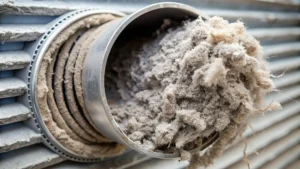
The first is construction fines, which is the expected one. A gray coating through the runs and packed into the coil face, heaviest in the returns.
The second is debris that should never have been there. Drywall offcuts, scraps of insulation, drink containers, and on more than one occasion a trowel. Registers sit open during construction and things end up inside.
The third is physical damage, and this is the one worth the inspection on its own. Flex duct crushed by someone kneeling on it in the attic, a run separated at a boot, a kink that never got straightened before the ceiling closed up. None of that shows up on a walkthrough and all of it explains a room that will not cool.
If you are still in your first year
Do this in an order that protects your warranty position.
Document any room that conditions poorly, with dates and specifics, and raise it with the builder in writing while the warranty is live. Get the inspection so you have footage of the actual condition. Then decide about cleaning based on what is in the footage and on whether the neighborhood is still under construction.
Homeowners who do it in that order tend to get problems fixed by the builder. Homeowners who clean first and complain later have removed their own evidence.
Realistic expectations about the first two years
A new house in an actively building subdivision is going to be dustier than the same house will be in five years. Some of that is your ductwork and some of it is simply the neighborhood, and it is worth being honest that cleaning does not fix the second part.
What it does is stop your own system from being a reservoir that keeps redistributing construction fines back into your rooms every time the air kicks on. That is a real improvement and it is also a bounded one.
If someone promises that a duct cleaning will end the dust in a new build surrounded by construction, they are overselling. The dust outside keeps arriving until the streets are paved and the lots are landscaped.
The one thing worth doing today
Pull your filter out and look at it, regardless of when you moved in or what the box says about ninety days.
In a new build in an active phase, that filter tells you more about your situation than anything else you can check for free. If it is gray across the whole face after a month, your system is working hard against a dusty environment, and that is worth acting on before it packs into the coil.
If you are buying rather than already moved in
Ask the builder directly whether the duct system was cleaned before closing, and ask what that actually consisted of. Get the answer in writing if you can.
Ask whether the HVAC system was run during construction, because that single answer tells you most of what you need to know about how deep the construction dust went.
The Unmatched $499 Complete-System Clean
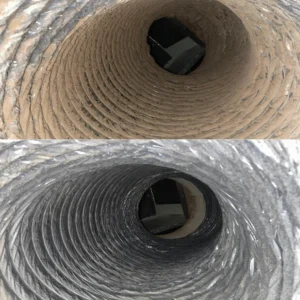
For $499, one HVAC system cleaned end to end: the supply ducts, the returns, every register, the air handler, the blower, the accessible coil and the dryer vent, every component brushed, vacuumed and disinfected, with before-and-after video so you see exactly what is going on inside. Nothing is due up front.