Almost every duct cleaning company in Phoenix will tell you your ducts were dirty. Very few will show you.
That gap is the entire reason we film the job, and it is worth explaining what the footage actually shows, because a video inspection is not a marketing gimmick and it is also not magic. It is a camera in a place you cannot otherwise see.
Why this industry has a trust problem
Duct cleaning has a reputation, and it was earned. The pattern is familiar to anyone who has been in a Phoenix home for a few years. A very cheap price gets advertised, someone shows up, and within ten minutes the number has grown considerably because of something alarming they found and described but did not show.
The structural problem is that ductwork is invisible. You cannot verify a claim about the inside of your walls, and you cannot verify the work afterward either. You are asked to take both on faith.
A camera removes the faith requirement in both directions. It also removes our ability to exaggerate, which is the point.
What you are actually looking at
The interior duct surface
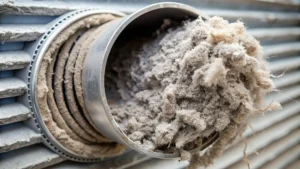
The first thing the camera shows is the inside wall of the duct run. In a system that needs cleaning you see accumulated material lying along the bottom of the run, and often a fuzzy layer clinging to the sides.
What surprises people is how uneven it is. Some runs are nearly clean and others are heavily loaded, usually depending on how much air moves through them and how many bends the run has.
The joints and connections
This is the part with actual diagnostic value. You see whether the connections are still sealed, whether flex duct has separated at a boot, and whether anything has been crushed or kinked.
A kinked flex run is a room that never cools properly, and it is a five minute fix that nobody finds because nobody looks. We have found rooms that had been uncomfortable for years because of a duct that got stepped on during a roof repair.
The insulation
On attic runs, you see whether the outer insulation is intact. Torn or degraded insulation in a Phoenix attic means your cooled air is fighting a hundred and forty degree environment through a thin barrier, and it means the duct sweats and can grow things.
The coil and blower
These are where efficiency actually lives, and they are the parts most often skipped by cheap operators because they take time. Seeing your own coil face is usually the most persuasive part of the footage for people, because a fouled coil looks obviously wrong even to someone who has never seen one before.
What good footage looks like: it should be from your house, taken during your visit, and it should include the parts that are not flattering to us. If every clip is a dramatic before and a sparkling after with no context in between, treat it as an advertisement rather than an inspection.
What the video will not tell you
It will not measure air quality. A camera sees debris. It does not sample particulates and it cannot tell you what you are breathing.
It will not identify mold species. Something dark and fuzzy on video is something that warrants attention, but naming it requires testing, and any company that identifies mold species from a video screen is telling you a story. If it genuinely looks like a growth issue, that is a conversation about mold remediation and possibly a testing service, not a duct cleaning upsell.
It will not see everything. Cameras go where cameras fit. Some sections of a residential system are not accessible without opening things up, and honest footage has gaps.
Before and after, and what the after honestly proves
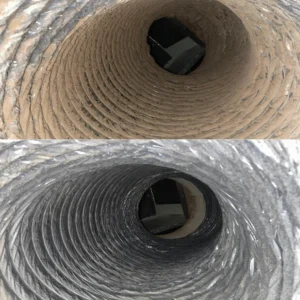
The after footage proves that the surfaces the camera can reach are clean. That is a real thing and it is worth having.
What it does not prove is a health outcome. We are careful about this because the industry is not. Cleaning removes accumulated material from your system. Whether that changes how anyone in the house feels depends on far more than duct condition, and we would rather under-promise that than sell you a result we cannot control.
What we can say plainly is that you will be able to see the difference between the two clips, and you will know what you paid for.
Sometimes the honest answer is do not bother
This is the part that costs us money and is the reason the camera goes in before the equipment comes out.
Some systems do not need cleaning. A newer home with a good filter and a diligent owner can look genuinely fine inside, and when it does, the right thing to say is that it looks fine and to check again in a few years.
If a company has never once told you your system was okay, that is worth thinking about.
How to use the footage after we leave
Keep it. It is a baseline.
Next time someone tells you your ducts are filthy, you have a dated record of what they looked like and when they were last serviced. If you sell the house, it is documentation of maintenance. If you are a landlord, it is a condition record per unit.
And if something changes fast between visits, that is diagnostic in itself. A system that reloads quickly is usually telling you about a leak, a filter problem, or something getting in that should not be.
What to ask any company you call
Ask whether the inspection happens before the quote or after. Before means they are diagnosing. After means they are justifying.
Ask whether you get to keep the footage. Ask whether they will show you the coil and blower, not just the duct runs. And ask what happens if they find nothing wrong.
The answers will sort the field quickly.
What the camera cannot replace
Video is evidence, but it is not the whole diagnosis, and it is worth being clear about where it stops.
It does not measure static pressure, which is the number that tells you whether your system is fighting a restriction. It does not measure airflow at the registers. It does not tell you whether your equipment is correctly sized for the house, which in Phoenix is a common underlying problem that no amount of cleaning fixes.
If your real complaint is that one room never cools, the camera may find the cause, or it may find perfectly clean ducts and the answer lies somewhere else entirely. We would rather point you toward an HVAC conversation than sell you a cleaning that was never going to solve the problem you called about.
Why we started doing it this way
The short version is that explaining is worse than showing.
You can describe what is in someone’s return plenum for five minutes and watch them decide whether to believe you. Or you can hand them a screen. The second one takes ten seconds and there is nothing to argue about.
It also changes what happens on our side. When the customer is going to see the footage, there is no upside to overstating what is in there, and no way to skip the coil and hope nobody asks. The camera disciplines the work as much as it reassures the homeowner.
What people are usually surprised by
Two things, consistently.
The first is how localized the buildup is. People expect the whole system to look uniformly bad. In practice one or two runs carry most of it, usually the ones nearest the return or the ones with the most bends, and the rest can be close to clean.
The second is the coil. Most homeowners have never seen theirs and have no mental image of what one should look like. When they see the fins packed with a gray mat, the connection between that and their power bill is immediate in a way that no explanation achieves.
A note on photos versus video
Some companies show still photos. Stills are better than nothing and worse than video, for one specific reason.
A still can be from anywhere. It has no context, no continuity, and no way to tell whether it came from your house or a stock library. Video with continuous movement through your actual run is much harder to fake and much easier to trust.
If you are shown a dramatic still image and asked to approve additional work on the strength of it, ask to see the video it came from.
The simplest way to think about it
You would not accept a mechanic telling you the inside of your engine was full of sludge, charging you to fix it, and handing back a closed hood with no explanation. You would want to see something.
Ductwork is the same situation with worse visibility, and the industry has traded on that for a long time. A camera is not a feature. It is the minimum standard for asking someone to spend money on a problem they cannot see.
The Unmatched $499 Complete-System Clean
For $499, one HVAC system cleaned end to end: the supply ducts, the returns, every register, the air handler, the blower, the accessible coil and the dryer vent, every component brushed, vacuumed and disinfected, with before-and-after video so you see exactly what is going on inside. Nothing is due up front.