We get a particular kind of call from businesses in this valley. Somebody in the building has complained about the air, or a tenant has raised it in writing, or an inspection is coming, and the person calling us has been told they need the ducts disinfected. Nine times out of ten that person does not actually know what they are asking for, because the word covers at least three different services at three very different prices.
This is written for whoever ends up owning that problem. Usually an office manager, a property manager, or an owner operator who has enough to do already and does not want to become an expert in ventilation to make one purchasing decision.
Start with the problem, not the service
The single most useful thing you can do before calling anybody is write down what actually happened. Somebody smelled something. Somebody got sick and blamed the building. There was a roof leak in March. A tenant put a complaint in writing and you now need a documented response. An inspector is coming and you want to be ahead of it.
Those are five completely different situations and they lead to different work. A vendor who quotes the same package for all five is selling a package, not solving your problem. When we get a clear description of what happened we can usually tell a business over the phone whether they need us at all, and a fair number of the time the answer is that they do not.
Three services get sold under one word
Cleaning
Physical removal. Vacuum, brushes, negative pressure, taking material out of the system. This is the foundation and it is what most buildings actually need. Nothing else in this list works properly if the system is still loaded, because you cannot treat a surface you have not exposed.
Disinfection
Applying an agent to reduce microbial load on surfaces after they have been cleaned. It is a step, not a substitute, and its effect is time limited. A building that is disinfected without being cleaned has bought a treatment applied on top of the debris.
Decontamination
A larger response to a specific known event. Water intrusion, sewage, smoke, confirmed mould growth. This is a project with containment and a defined scope, not a service you schedule quarterly, and if somebody is proposing it without naming the event that triggered it, ask what they think happened.
Who is responsible in a leased building
This trips up more businesses than anything else on this page. In most commercial leases the mechanical systems serving the whole building belong to the landlord, while anything inside your demised space may be yours. Rooftop units serving only your suite are frequently your responsibility and frequently a surprise.
Before you spend anything, find out which side of that line the equipment sits on. We have quoted work for tenants who did not need to pay for it, and we would rather tell somebody to send the quote to their landlord than take the job. Read the lease, or have whoever handles your lease read it, because the answer changes who signs.
Shared systems make it a neighbour problem
In a multi tenant building on a shared air handler, your indoor air is partly a function of what the other suites are doing. A restaurant, a nail salon, a print shop or a gym on the same system will show up in your space, and no amount of work inside your own suite fixes a source two doors down.
If you are on a shared system, the useful conversation is with the property manager and it is about the whole system, not your portion of it. Spending your own budget on a shared problem is the most common way commercial money gets wasted in this trade.
The complaint that usually starts this
Most commercial calls begin with a smell, and most commercial smells turn out to have a source that has nothing to do with ductwork. Dry floor drains are the leading cause we find. A drain that has not seen water in weeks stops holding its seal and the building starts venting sewer gas into a corridor.
Others we have traced include a saturated ceiling tile above a suspended grid, a condensate pan backing up, and once a bathroom exhaust fan that had been wired to a switch nobody used since the building changed hands. All of those present as a duct problem to the person who has to answer for it, and none of them are.
What we would look at before quoting
The return air path
Many commercial buildings use the ceiling plenum as the return. That means the space above the tiles, with all of its dust, insulation and whatever else is up there, is part of your air path. It also means a leak or a dead rodent above the grid ends up in the occupied space quickly.
The coil and drain pan
Same as in a home but larger and running far more hours. On a commercial unit that runs most of the year, the pan is the most likely place for standing water and for something biological to establish.
When a business genuinely needs this
After water gets in
A roof leak, a burst line, a failed condensate pan. Water plus dust plus the dark equals a real problem on a real timeline, and this is the situation where moving quickly actually matters rather than being a sales line.
Food service, medical and dental
Where there is a regulatory or licensing dimension, documented work has value beyond the work itself. If an inspector may ask, you want a record you can hand over rather than an assurance.
When it is being sold to you and should not be
A quarterly disinfection contract on a standard office with no complaint, no event and no regulatory driver is a subscription. So is any proposal that arrives with urgency but without a named cause. If a vendor cannot tell you what specifically they found, in your building, with something you can look at, then what you are buying is reassurance.
We would rather clean a system once, show you the footage, and have you not call us for three years. That reads as a worse business model on paper and it is a better one in practice, because commercial customers in this valley talk to each other far more than homeowners do.
Scheduling is most of what you are paying for
Commercial work usually has to happen when the space is empty, which means evenings, weekends or a shutdown window. That constraint, not the square footage, drives a large part of what a commercial quote costs.
It is also the thing you have the most control over. A business that can offer a genuinely flexible window, or a long weekend, gets a materially better number than one that needs a specific Tuesday night. Say so when you ask for the quote. The same goes for access. If somebody on your side can let a crew in and lock up afterwards without a security escort being billed by the hour, that is real money and it is worth arranging.
What to ask for in writing
Which units and which zones by name. Whether returns and trunk lines are included or only the branches. Whether coils and blowers are included. Whether any treatment is being applied, what it is, and whether a safety data sheet comes with it. What documentation you will receive at the end. And what hours the work happens in, because that is where a quote quietly changes.
Any commercial vendor who cannot produce that in writing before starting is not set up for commercial work, whatever their sign says.
Documentation matters more here than in a home
For a homeowner the video footage is reassurance. For a business it is a record. If a tenant complained in writing, or an employee raised a concern, or you are heading into an inspection, the thing with lasting value is being able to show what the system looked like, what was done, and on what date.
We provide footage on commercial work for that reason. Keep it with the lease file rather than in somebody’s inbox, because the person who needs it in two years is often not the person who ordered the work.
The Unmatched $499 Complete-System Clean
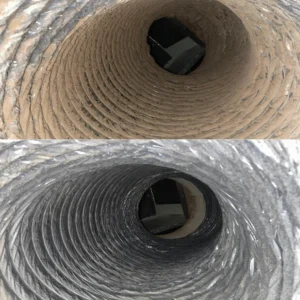
For $499, one HVAC system cleaned end to end: the supply ducts, the returns, every register, the air handler, the blower, the accessible coil and the dryer vent, every component brushed, vacuumed and disinfected, with before-and-after video so you see exactly what is going on inside. Nothing is due up front.
We know the Phoenix Valley
We are family owned and have worked this valley since 2015, out of offices in Phoenix, Gilbert and Sun City. Our main office is at 2720 E Thomas Rd, Building C, Unit 270, Phoenix. We are BBB accredited, we hold a 4.7 star rating across more than 800 Google reviews, every job carries a one year warranty, and we answer the phone 24 hours a day.
If you have a complaint on file and need somebody to tell you what is actually causing it, call us at (623) 200-4222. We will look at the system, show you the footage, and give you a written scope you can put in front of a landlord or an inspector.