Gray-black streaks on the ceiling, fanning out from the edges of a supply vent. Maybe a dark film on the grille too, one that comes back a few weeks after you wipe it off.
Most people look at that and assume the ducts are filthy. Sometimes they are. A lot of the time they are not. Black dust from air vents has several common causes, and only some of them live inside your ductwork. Where the black shows up, and when it started, will tell you a lot before anyone opens up your system.
Start by looking at where it is
Walk the house before you call anyone. Check every supply vent (the ones that blow air out) and every return (the larger grilles that pull air back in). Then ask yourself a few questions.
- Is it on every vent, or only in one or two rooms?
- Is it on the ceiling or wall around the vent, on the grille itself, or inside the duct when you shine a flashlight in?
- Did it start after something changed? A new candle habit, the first cool night with the heat on, a dust storm, work on the house.
- Does it wipe off as dry dust, or does it smear?
Keep those answers handy. They line up with the six causes below.
1. Candle soot
Candles give off fine black soot, and scented jar candles are some of the worst for it, especially when the wick is long or the flame flickers. That soot floats around the room until your system pulls it into a return. Then it gets blown back out through the supply vents.
Air leaving a supply vent sweeps across the ceiling, and the finest particles stick to the surface along that path. That is why candle soot tends to show up as streaks around the vent rather than a neat ring on the grille. It also tends to smear when you wipe it.
The clue is timing and location. If the black is worst in rooms where you burn candles, or it showed up after a season of burning more of them, start here. Trim wicks short, burn fewer candles for a few weeks, change the filter and clean the ceiling. If it does not come back, you found your answer and you did not need us.
2. A fireplace, or a fuel-burning appliance
A fireplace that gets a lot of use, or one that lets smoke drift back into the room, can leave soot in the house. Your system spreads it from there.
The gas furnace is the one to take seriously. If you have a gas furnace, gas water heater or any other appliance that burns fuel, and black soot shows up, do not just wipe it and move on. Pay special attention if it appeared right after you ran the heat for the first time in fall. Soot can be a sign that something is not burning the way it should.
If you see soot and you have a gas furnace or another fuel-burning appliance, have that appliance checked by a licensed HVAC technician, and make sure your home has working carbon monoxide alarms. The EPA recommends having fuel-burning furnaces, stoves and fireplaces inspected and serviced before each heating season to protect against carbon monoxide poisoning. We clean furnaces and air handlers. Checking how a gas appliance is burning is a job for that technician.
No need to panic. Most black ceilings trace back to something far more ordinary. But this is the one cause where the right professional comes before any cleaning.
One fall note. After a long Phoenix cooling season, the first run of the heat can stir up dust that settled in the system, sometimes with a dusty smell. Gray dust that fades quickly is probably that. Black that keeps coming means back to the box above.
3. A dirty or poorly fitting filter
Your filter is the cheapest part of the system, and it gets blamed last. A filter that is overdue gets so loaded that it stops doing much. A filter that is the wrong size, or sits loose in its slot, lets air slip around the edges and carry dust right past it.
The clue here is that the dark dust shows up on vents all over the house, not just one room. Pull the filter. If it is dark gray, past its change date, or slides around in the frame, fix that first. Our own advice on dust is that the best results usually come from using the correct filter and changing it regularly. Cleaning ducts while a bad filter keeps letting dust through just resets the clock.
4. Outdoor dust and soot
Phoenix homes deal with desert dust, and monsoon season adds more of it. Smoke and soot from outside find their way in too. Every time a door opens or air leaks in around windows, some of that comes along, and the HVAC system moves it around the house.
The EPA makes the same point from the other direction. Dirty ducts are only one of many sources of particles in a home, and pollutants from outdoors, plus everyday things like cooking and smoking, can matter more than the ducts do.
The clue is when it got worse. If the black dust picked up after a dust storm or during a smoky stretch, outdoor air is a likely suspect. Duct cleaning will not stop that. A good filter, changed on time, does more.
5. Dirty ducts, returns or a breaking-down duct liner
Sometimes it really is the system. Heavy buildup inside the ducts or the return can get knocked loose when the system starts up, and you see a little puff of dust or dark specks on the furniture under the vent.
The other possibility is the duct material. A lot of attic ductwork is flex duct, which has an inner liner and insulation wrapped around it. As that material ages in a hot attic it can break down, and bits of it can come out through the vents as dark flakes or fibers rather than fine powder.
The clue is that it shows up at only one or two registers, often the ones fed by the same run. The EPA lists particles actually coming out of supply registers as one reason to consider duct cleaning, and it also says to correct the underlying cause first. If a section of duct is damaged, crushed or falling apart, cleaning it will not fix it. We repair and replace damaged duct sections, and we price that separately so you can decide. Our air duct cleaning page explains what a cleaning covers when the ducts are the problem.
6. Something that looks like mold
Black spots on a grille or on the ceiling next to a vent make a lot of people think mold. It could be. It could also be dust or soot, and the two can look the same in a photo or even on a camera inside the duct.
That is why we start with an inspection and do not call something mold based only on how it looks. The technician documents what is there, checks for moisture or water problems, and tells you whether testing makes sense. If it is mold, the moisture source has to be fixed or it comes back. Regular duct cleaning is not always enough for active mold, and the EPA says wet or moldy duct insulation cannot be cleaned well and should be replaced instead.
The clues are a musty smell, water stains or condensation near the vent, or spots that keep returning to the same place. Our post on mold in air ducts in Arizona goes deeper on this.
Putting the clues together
- Streaks around supply vents in rooms where you burn candles: start with the candles.
- Black dust on vents all over the house: check the filter and think about outdoor dust before anything else.
- Only one or two registers: look at that duct run, its liner and whatever is near it.
- Showed up the first time the heat came on in fall: if you have a fuel-burning appliance, get it checked first.
- Spots plus a musty smell or moisture: inspection before anyone treats it as mold.
When an inspection with video makes sense
Try the easy fixes first. If you changed the filter, cut back on candles and cleaned the ceiling, and the black still comes back, it is time to look inside. Same if it only shows up at a couple of vents and nothing in your house explains it, or if there is a smell you cannot place.
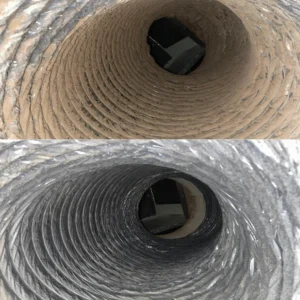
During an inspection, our technician looks at the accessible vents and returns, the duct access points and the furnace or air handler. We use video to show you what is actually in there. That might be heavy buildup in the ducts or around the blower and coil. It might be a crushed or disconnected section, or a liner that is falling apart. It might be something that needs a moisture check before anyone calls it mold.
And sometimes the video shows ducts that are pretty clean. Then cleaning them will not fix your ceiling, and we will tell you that. Our FAQ says it plainly: duct cleaning may not be necessary when the ductwork is already clean. If you do go ahead, you get before-and-after video from inside your own system so you can see the difference.
What it costs
Air duct maintenance cleaning starts at $169 for one A/C system. Deep cleaning, for heavier buildup or contamination, starts at $499. If the inspection finds buildup on the furnace or air handler itself, our furnace cleaning starts at $349. These are starting prices, and the final quote is confirmed on site before any work begins. You can see the full list on our pricing page.
The Unmatched $499 Complete-System Clean
One HVAC system. Ducts, returns, registers, air handler, blower, coil and dryer vent. Every component brushed, vacuumed and disinfected. Nothing due up front, and we do not accept payment from unhappy customers.
We know Phoenix
We are a family-owned company and have been cleaning air ducts and dryer vents across the Phoenix Valley since 2015. We are licensed and insured, BBB accredited with an A rating, and rated 4.7 stars across more than 800 Google reviews. We answer the phone 24 hours a day.
If black dust keeps coming back and you want someone to look, call us at (623) 200-4222 or book a visit online. We will show you what is in your system and tell you honestly whether cleaning will help.