Your air conditioner makes water every time it cools. Warm air from your house passes over a cold coil, moisture in that air condenses on the metal, and the water drips into a pan and runs out through a drain line. That happens all day, every day the AC is running, which in Phoenix is most of the year.
When everything works, the water leaves and you never think about it. When it doesn’t, the water sits somewhere dark, dust settles into it, and after a while the air coming out of your vents smells like a damp towel left in a gym bag. That’s the musty smell most people are asking about.
So the useful question isn’t “why does my AC smell?” It’s “where is the water sitting?” Answer that and you usually know who needs to fix it.
First, is it really musty?
Musty is that stale, damp, closed-up-cabin smell. It’s worth being sure that’s what you have, because other smells point somewhere else entirely.
A burning or electrical smell is not a cleaning issue. Turn the system off and call an HVAC technician. A rotten-egg smell can mean a gas leak. Leave the house and call your gas company or 911 from outside. A dusty smell the first time you run the heat in winter is common and usually burns off. A sharp, dead-animal smell coming from one or two vents can mean something crawled into the ductwork, which is its own problem.
If it’s that damp, mildew-type odor, keep reading.
Where the smell usually starts
We look at these in roughly the order they tend to show up, starting with the simplest.
The air filter
A filter that’s packed with dust holds onto whatever moisture and odor is in the air passing through it. It also chokes airflow, which can make the coil run colder and wetter than it should. Start here, because it’s cheap and you can do it yourself in a few minutes. If the filter is gray and caked, change it and give the house a day.
The evaporator coil and drain pan
This is the most common source. The indoor coil (the evaporator coil, inside your air handler or furnace cabinet) is supposed to be wet when the AC is cooling. That’s its job. The trouble starts when dust builds up on those wet fins. Dust plus constant moisture gives odors, and sometimes growth, a place to settle in.
The drain pan under the coil is the other half of it. If water doesn’t drain all the way out, the pan holds a little standing water and gunk between cycles. Every time the blower kicks on, air passes right over it on its way to your rooms.
A clogged condensate drain line
The condensate line is the small pipe that carries water from the drain pan out of the house. Over time it can slowly clog with sludge and debris. When it backs up, water stays in the pan, sometimes overflows it, and the smell follows. A partly clogged line is sneaky because the AC keeps working fine. The only clue might be the smell, or a little water where there shouldn’t be any.
A unit that shuts off too fast
This one surprises people. An AC unit that’s too big for the house can cool the air quickly and shut off before it has run long enough to pull much moisture out. That’s called short-cycling. The house hits the thermostat setting but stays clammy, and clammy air plus a coil that never fully drains can leave things smelling stale. You’ll notice the system turning on and off a lot in short bursts.
Running the fan in the “on” position all the time can do something similar. After a cooling cycle, the coil is still wet, and a fan that keeps blowing across it can push some of that moisture right back into the house. If your thermostat fan is set to “on,” try “auto” for a few days and see whether the smell changes.
Moisture inside the ducts
Ducts are supposed to be dry inside. They get wet when something goes wrong. Water can overflow from the drain pan into the supply side. Ducts running through a hot attic can sweat. A disconnected section can pull in humid air. Once dust inside a duct gets damp, it can hold onto a musty smell long after the water is gone.
Phoenix doesn’t get humid often, but monsoon season brings occasional moisture into homes that are otherwise bone dry. If you only notice the smell in late summer, that’s a clue worth mentioning to whoever looks at your system.
A leak in the attic or closet
Plenty of Valley homes have the air handler in the attic or a hallway closet. A slow roof leak above it or an overflowing drain pan can soak the insulation and the platform the unit sits on. The smell then gets pulled into the return and blown through every room.
Something got into the ducts
Construction dust from a remodel, pet hair, debris from a damaged duct, or an animal nest can all end up inside the ductwork. On their own they’re mostly a dust problem. Add a little moisture and some of them start to smell.
What you can check yourself
You don’t need tools for most of this. A flashlight helps.
- Change the air filter if it’s dirty, and write down the date.
- Notice when the smell happens. Only in the first minute after the AC kicks on points toward the coil and drain pan. All the time, or stronger at night when the house is closed up, can point toward ducts or a leak.
- Notice where it happens. Every vent in the house usually means the source is at the air handler. One room or one end of the house points toward a specific duct run.
- Find where the condensate line exits the house (often a small pipe near the outdoor unit or on an outside wall). On a hot day with the AC running, it should drip. Dry while the AC has been cooling for a while can mean a clog.
- If you can safely see the air handler, look for water around the base, rust, or a pan that looks full.
- Check the ceilings near your supply vents for water stains or soft spots.
- Take off one register cover and shine a light inside. You’re looking for dampness, heavy dark buildup, or debris.
One honest warning about that last check. Dark stuff inside a duct is not automatically mold. Dust and soot can look a lot like it, in person and on video. That’s why we inspect before we call anything mold.
When it’s a repair problem
If what you found is water that isn’t going where it should, start with the water. A clogged drain line, an overflowing pan, a leak in the attic, a unit that short-cycles or a duct that’s sweating are repair issues. Those are jobs for an HVAC technician, or a roofer or plumber if the leak is coming from the house itself.
This part matters more than anything else in this post. Cleaning a system that’s still getting wet is paying to reset the clock. The smell comes back, and if there’s growth, so does that. Our own position is plain: fix the moisture source first, or it returns.
When it’s a cleaning problem
Once the water problem is handled, or if there never was an active one, what’s left is the residue. That’s where we come in.
Here’s how we’d usually match the service to what we find. If the smell is coming from a dirty, damp coil, indoor coil cleaning starts at $199. If the system is clean enough but holds a lingering odor, full system disinfecting starts at $199. If an inspection shows suspected mold through the system, full system mold treatment starts at $499 and comes with a 2-year warranty and two free annual inspections. All of these are starting prices, and we confirm the final price on site before any work begins.
We don’t skip straight to mold treatment because someone smelled something. A musty smell is not proof of mold. It can come from damp dust, a dirty pan, or old water damage that has already dried out. We look first, show you on video what’s in there, and explain what we think is causing it.
And if it does turn out to be active mold, regular duct cleaning is not always enough. Depending on how much of the system is affected and whether moisture is still present, it may need full-system treatment, and larger or structural problems can need a dedicated mold specialist. We’ll tell you which it is. If you want more background on that side of things, our post on mold in air ducts in Arizona goes deeper, and our mold remediation page explains what the treatment covers.
What we’d want to know when you call
It helps us a lot if you can tell us a few things up front. When the smell shows up, whether it’s every room or just some, whether you’ve had any leaks or AC repairs lately, and when the filter was last changed. If an HVAC company already cleared a drain line or fixed a leak, tell us that too. It changes what we look for.
You can see every starting price on our pricing page, and the disinfecting service page explains what that visit includes. If you have questions about how we handle odors and mold, our FAQ answers most of them.
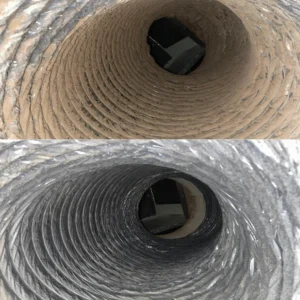
Every job gets before-and-after video, so you see the inside of your own system instead of taking our word for it.
The Unmatched $499 Complete-System Clean
One HVAC system. Ducts, returns, registers, air handler, blower, coil and dryer vent. Every component brushed, vacuumed and disinfected. Nothing due up front, and we do not accept payment from unhappy customers.
We know Phoenix
We’re family owned and have worked on air ducts and dryer vents across the Phoenix Valley since 2015. We’re BBB accredited, we hold 4.7 stars across more than 800 Google reviews, and we answer the phone 24/7.
If your vents smell musty and you want someone to look, call us at (623) 200-4222 or book online. We’ll find where it’s starting and let you know whether it needs us or a repair first.